
Business Analysis in 2026: From Requirements Gathering to Decision Intelligence


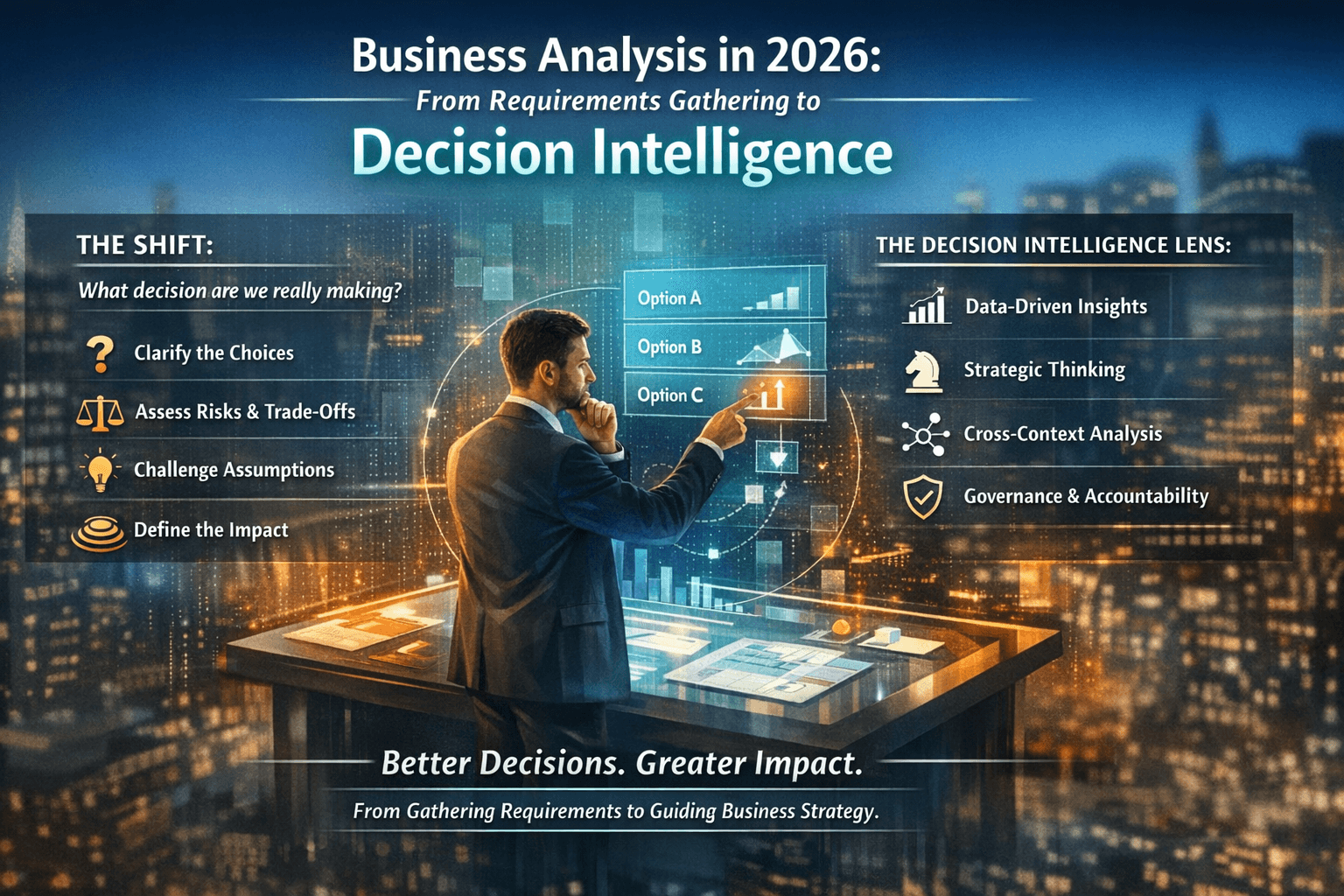
In 2026, the most valuable contribution a business analyst can make is no longer documentation, process maps, or even solution design.
It is decision clarity.
We operate in an environment defined by complexity, speed, uncertainty, and consequences. Organisations are not failing because they lack requirements. They are failing because they are making poorly framed, poorly informed, and poorly governed decisions. This reality is reshaping the profession of business analysis at its core.
The business analyst of 2026 is no longer a translator between business and IT. They are becoming decision analysts, decision architects, and increasingly decision intelligence partners to leaders.
The Shift: From “What Should We Build?” to “What Decision Are We Really Making?”
Traditional business analysis focused on:
- Capturing requirements
- Documenting processes
- Supporting solution delivery
These skills are still necessary, but they are no longer sufficient. In 2026, high-performing organisations expect business analysts to help answer more complex questions:
- What decision is this initiative trying to enable?
- What uncertainty are we trying to reduce?
- What assumptions are we making, and what happens if they are wrong?
- What trade-offs are leaders being asked to accept?
This marks a shift from solution-focused analysis to decision-focused analysis.
Instead of starting with requirements, the 2026 BA begins with:
- The decision that must be made
- The options available
- The risks, constraints, and uncertainties
- The impact of that decision across portfolios, customers, and time
These areas are the foundation of Decision Intelligence.
Decision Intelligence: The New Core of Business Analysis
Decision Intelligence brings together data, analytics, human judgment, and governance to improve decision-making, not just how systems are being built.
For business analysts, this means a fundamental change in posture.
In 2026, a BA must be able to:
- Frame decisions clearly before solutions are discussed
- Separate facts from assumptions
- Use data to inform decisions, not overwhelm them
- Make uncertainty explicit rather than hidden
- Support leaders in making defensible, transparent choices
The value of a business analyst is no longer measured by how well they document the past, but by how well they help the organisation choose its future.
AI’s Role: Augmenting Judgment, Not Replacing It
Artificial Intelligence is accelerating this shift, but not in the way many expected. AI is not replacing business analysts. It is replacing low-value analytical labour.
In 2026:
- AI automates data collection, cleansing, and pattern detection
- Machine learning models surface trends, risks, and probabilities
- Natural language tools summarise insights at scale
What AI cannot do is:
- Decide what matters
- Judge trade-offs between competing values
- Understand organisational context, politics, and consequences
- Take responsibility for decisions
This is where the business analyst steps in.
The 2026 BA uses AI to support decision analysis, not to abdicate it. They ask better questions of the data, challenge algorithmic outputs, and ensure AI-driven insights align with business intent, ethics, and risk appetite.
In short:
AI provides speed and scale; the business analyst provides judgment and accountability.
Automation: Freeing the BA to Work Where Risk Lives
Automation has removed much of the manual work that once defined business analysis. Systems increasingly handle reporting, traceability, and routine analysis. It is not a threat, it is an invitation.
In 2026, the BA’s value lies in:
- Interpreting automated outputs
- Explaining implications to decision-makers
Identifying second and third-order impacts
Designing decision frameworks that scale across teams and portfolios
Automation handles execution, Business Analysts handle consequence.
Agile, Reframed: Decisions Over Backlogs
Agile has matured, and with that maturity comes a new challenge: speed without clarity creates noise.
In agile environments, business analysts are no longer backlog custodians. They are:
- Decision facilitators within fast-moving teams
- Guardians of intent as priorities shift
- Anchors of coherence across iterations
Requirements change because decisions change.
The BA of 2026 ensures that teams understand:
- Why does a priority exist
- What decision does it support
- What success looks like
- What risks are being consciously accepted
Agile delivery without decision clarity leads to local optimisation and global failure. The modern BA prevents this by keeping decision logic visible and aligned.
What the Business Analyst of 2026 Must Now Master
Looking forward, the profession will increasingly demand capability in:
- Decision Framing: Clearly defining the decision before analysing solutions.
- Decision Analysis & Trade-Off Thinking: Understanding options, uncertainty, risk, and impact.
- Data-Informed Judgment: Using analytics and AI to inform, not replace, human reasoning.
- Cross-Context Influence: Seeing how decisions in one area affect others across the organisation.
- Decision Governance: Ensuring decisions are transparent, explainable, and accountable.
- Strategic Partnership: Working with leaders as a thinking partner, not a delivery assistant.
Conclusion: The Business Analyst as a Decision Professional
In 2026, organisations do not need more documentation; they need better decisions. The business analysts who will thrive are those who step into this space and move beyond traditional BA boundaries, positioning themselves as decision intelligence professionals.
Those who can make complexity understandable, turn uncertainty into structured choices and help leaders decide with confidence and clarity. It is not the end of business analysis. It is its evolution into relevance.
And for those willing to make this shift, the opportunity has never been greater.